Learn › Become a NY Home Inspector › Week 2
Week 2 · Module 1: Structure, exterior & roofRoof coverings: pitched and flat
AI-narrated. A recording by Onelfri is coming soon.
In the NYC area you'll inspect two very different kinds of roofs: the flat or low-slope roofs on row houses, brownstones and apartment buildings, and the pitched roofs on detached houses in the outer boroughs, Long Island and the counties north of the city. The NY Standards of Practice ask you to observe and report on readily accessible roofing materials and condition, and every report must describe the type and condition of the roofing and the methods you used to observe it. This lesson covers what you're looking at, how roofs age, and how to inspect without getting hurt.
What the SOP asks for
Here's the core of the roof section of the NY Standards of Practice (19 NYCRR § 197-5.7, in the DOS law and regulations PDF):
- Observe and report on readily accessible roofing materials and condition, roof drainage systems, flashing, and skylights, chimneys and roof penetrations.
- Describe the type and observed condition of the roofing materials, and the methods used to observe the roof.
- You are not required to determine remaining life expectancy, manufacturers' defects, installation methods or recalls, or the number of roof layers.
- You are not required to walk on or access a roof where doing so could damage it or endanger your health and safety.
That last point matters. "Walked the roof," "viewed from the roof hatch," "viewed with binoculars from the ground" and "viewed by drone" are all methods. Write down which one you used, every time. If you couldn't see part of the roof, say so.
Safety: Stay off roofs that are wet, icy, steep, brittle, soft underfoot, or that you can't reach safely. Don't climb a ladder you don't trust. Use binoculars, or a drone where the rules allow it. Then report exactly what wasn't walked or seen and why.
Flat and low-slope roofs
"Flat" roofs aren't perfectly flat. They're built with a slight slope so water runs to a drain, a scupper or a gutter. On NYC row houses they usually sit behind a parapet, the short wall at the roof edge, topped with coping. Common coverings you'll see:
- Modified bitumen: asphalt-based rolled roofing laid in overlapping sheets, often with a granular or reflective surface. You'll see the seams as lines across the roof.
- Built-up roofing (BUR): several layers of felt and asphalt or tar, often topped with gravel or a coating. Common on older buildings.
- Single-ply membranes: EPDM (black rubber) and TPO (usually white), installed in large sheets with seams.
- Coatings: silver (aluminum) or white coatings brushed or sprayed over the roof to protect it and reflect sun. A coating can hide what's underneath, so describe it as a coated surface.
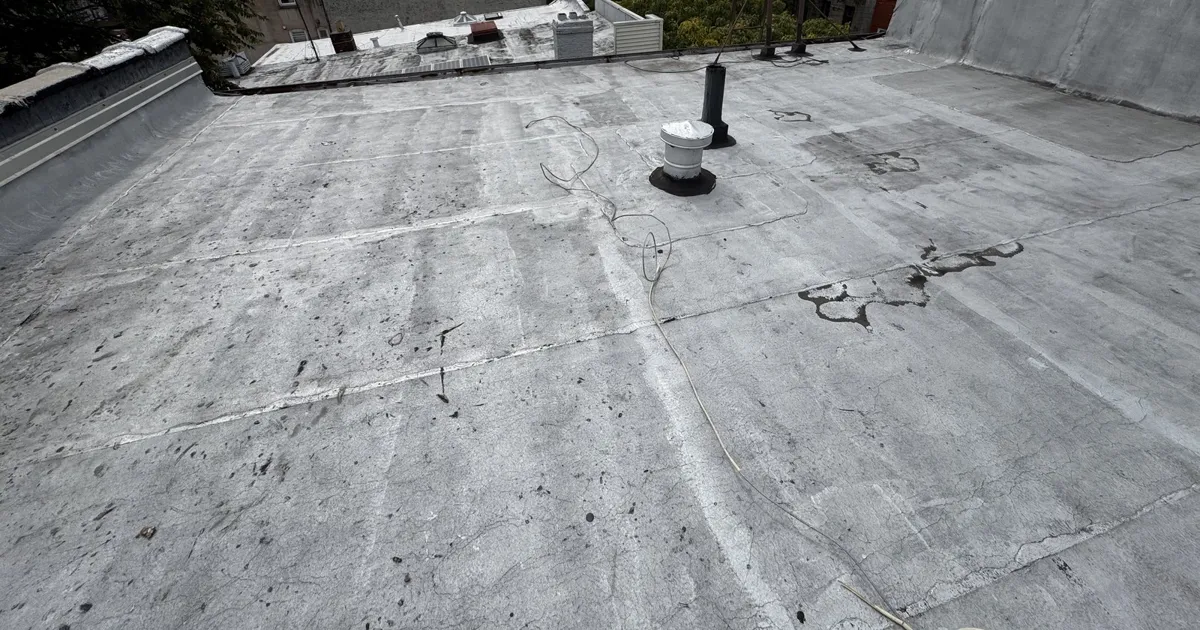
Signs of aging and trouble: worn or flaking coating, cracking and "alligatoring," blisters, open or lifting seams, many patches, soft or spongy areas underfoot, and debris. Ponding, water that stays in low spots after rain, is a common finding. Stains or dried rings on the surface can show where it sits. Report it, because standing water stresses the roofing and can find any weak seam.
Pitched roofs
On sloped roofs, the covering sheds water by gravity, with each piece overlapping the one below. You'll see:
- Asphalt shingles, by far the most common on houses. Aging signs: lost granules (look in the gutters too), curling or cupping, cracked or missing tabs, exposed nails, and moss or debris.
- Slate, on many older and higher-end homes. Look for cracked, slipped or missing slates and rusted fasteners. Don't walk on slate: it breaks, and it's slippery.
- Others, like wood shakes, clay or concrete tile, and metal roofing. Describe what you see and its condition.
Look for sagging ridge lines or a wavy roof plane, which can mean framing or decking problems you'll want to follow up from the attic. Note patched areas and different-looking shingles, since they show past repairs.
Writing it up
Every roof entry should cover the type, the method used to view it, the condition you observed with locations, and a recommendation. Don't guess at how many years the roof has left. The SOP doesn't require it, and a guess is easy to get wrong. When you see enough wear, patching or ponding, recommend evaluation by a qualified roofing contractor and say why.
Describe this defect
Write it up the way it would go in a report: what it is, where it is, why it matters, and what you'd recommend. It stays in this browser; nothing is sent anywhere.
Model write-up
REPAIR / EVALUATE. Roof type: coated flat roof (silver coating over rolled roofing); method: walked. The coating was worn in many areas, and multiple dark patches were observed, which indicate past repairs. Seams were visible across the roof. A loose cable was lying on the roof surface. Worn coating and repeated patching can mean the roofing is aging, and leaks can develop at seams and patches. Recommend evaluation by a qualified roofing contractor, recoating or repairs as needed, and securing or removing the loose cable.
Self-check: did your write-up…
Check yourself: 5 questions
Pick an answer to see instantly whether it's right. Your answers are saved in this browser.
Key takeaways
- The NY SOP has you report the roofing type, its condition and the method you used to observe it.
- You're not required to walk a roof if it could damage it or endanger you. Report what wasn't walked and why.
- Flat roofs in NYC are usually modified bitumen, built-up, EPDM, TPO or coated surfaces behind parapets.
- Watch for ponding, open seams, blisters, worn coatings and heavy patching on flat roofs, and for granule loss, curling and missing pieces on shingles.
- Don't estimate remaining roof life. Describe what you saw and recommend a roofer when it's warranted.
Finished the lesson? Mark it complete to save your progress in this browser.