Learn › Become a NY Home Inspector › Week 1
Week 1 · OrientationNY-specificNY license path and the law, step by step
AI-narrated. A recording by Onelfri is coming soon.
Before you learn a single thing about roofs or boilers, learn the rules of the job. In New York, home inspection is a licensed profession, and the Department of State (DOS) decides who gets a license and what licensees may and may not do. I walk new inspectors through this the same way every time: how you qualify, how you take the exam and apply, what you have to keep up once you're licensed, and the conflict-of-interest rules that protect your clients. Every fact on these screens links to the official source. Rules can change, so check the DOS pages before you make any decision.
Two routes to qualify
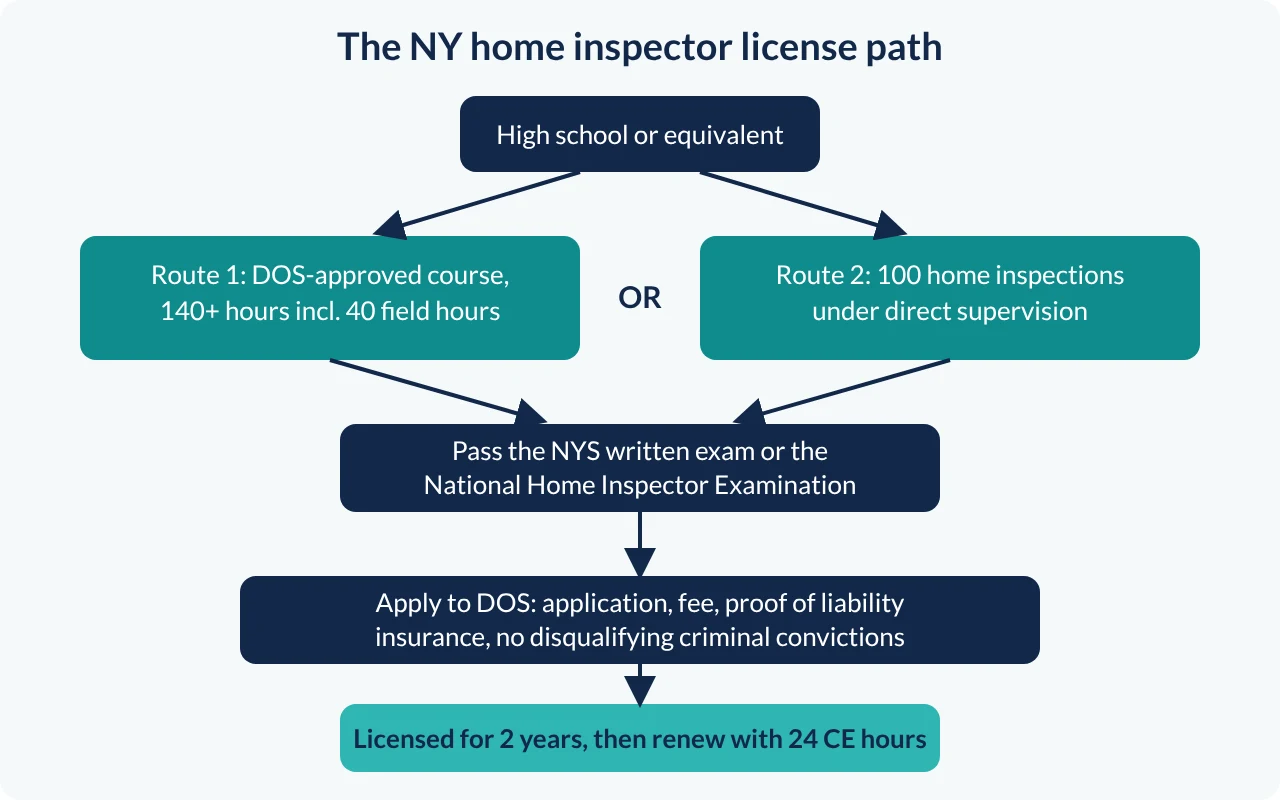
Everyone needs a high school diploma or its equivalent. After that, DOS gives you two ways to qualify (DOS: Become a Home Inspector):
- Route 1, the course: complete a DOS-approved course of at least 140 hours. The DOS syllabus splits it into four 25-hour classroom modules plus 40 hours of field training (19 NYCRR § 197-2.3). Those 40 hours must be unpaid, field-based inspections done in the presence of and under the direct supervision of a NYS licensed home inspector, or a NYS regulated professional engineer or architect.
- Route 2, experience: perform at least 100 home inspections, paid or unpaid, in the presence of and under the direct supervision of one of those same professionals.
One honest note about this track: it's free supplemental study material. It is not a DOS-approved qualifying course, and nothing here counts toward the 140 hours or the field hours. Approved schools are listed on the DOS page under Course Providers.
The exam, the application and insurance
The exam. You can pass either the NYS written examination or the National Home Inspector Examination. The National exam is run by EBPHI, and DOS explains that you register, schedule and pay for it through PSI (DOS: Qualifying Exam). DOS posts the NYS written exam schedule on its Become a Home Inspector page, and points National exam candidates to the EBPHI website for information and resources to help them prepare.
The application. You send a completed application and the fee to the DOS Division of Licensing Services. DOS also requires freedom from disqualifying criminal convictions (DOS: Become a Home Inspector).
Insurance. You must secure, maintain and file proof of liability coverage with DOS, with a minimum of $150,000 per occurrence and $500,000 aggregate (same source). Notice the word maintain. It isn't a one-time box to check.
Fees listed by DOS (same source):
| Item | Fee |
|---|---|
| Initial application (nonrefundable) | $250 |
| NYS written exam | $50 |
| Renewal | $100 |
| Change of name or address | $25 |
| Duplicate license | $25 |
DOS lists the National exam separately, through PSI, so check its cost there.
License term, renewal and continuing education
A home inspector license is issued for two years. The law lets DOS set a shorter or longer first term to stagger expiration dates, so read the date printed on your license (NYS Home Inspection Professional Licensing law and regulations, DOS PDF).
- You can renew starting 90 days before your expiration date, and DOS mails renewal forms about 90 days ahead (DOS: Renew or Update).
- To renew, you need 24 hours of approved continuing education completed within the two-year period before your expiration date (DOS: Home Inspector FAQ). The regulations also say the same course can't count for credit more than once in a renewal cycle (law and regulations PDF).
- The renewal fee is $100.
The law also sets day-to-day duties. Your license number and status go on every report and in all your advertising. You give the client a written report within five business days of the inspection, the report has to identify which systems and components you observed, and it's confidential unless the client says otherwise (RPL § 444-g).
Conflicts of interest: the rules I care about most
The law says it plainly: your duty is to the client. Here's what that means in practice (RPL § 444-g(4); regulations § 197-4.7 in the DOS law and regulations PDF):
- No repairs on homes you inspect. You may not perform, or offer to perform, for an extra fee, any repair, improvement or replacement of a component or system you reported on before closing.
- No paid referrals. You may not pay commissions, referral fees or kickbacks to the seller or to the agents for sending you business, and you may not pay brokers, lenders or anyone with a stake in the closing to get on a recommended list. You also may not take fees from contractors for work you reported on.
- No inspecting where you have a stake. You can't inspect a home that you, a partner or a relative has a financial interest in.
- No contingent fees. Your pay can't depend on what the report says or on whether the sale closes.
- Disclose first. Before you accept a job, tell the client about any known or potential conflict.
The agreement, the report and the limits. Before you inspect, you give the client a written pre-inspection agreement that describes the scope and the cost and includes the clauses the regulations require (§ 197-4.2). The client is the person you sign that agreement with. You don't share the report or your observations with anyone else without the client's or their representative's consent (§ 197-4.3). And an inspection is a visual snapshot of readily accessible conditions on that day: the SOP says it isn't technically exhaustive, and you aren't required to offer warranties or guarantees (§ 197-5.16(j) and (l)). It's not an appraisal either.
I tell every new inspector the same thing: your report is only worth something if the client knows nobody paid you to write it a certain way.
Your license path checklist
Pick your route and set target dates. It's saved only in this browser.
Check yourself: 5 questions
Pick an answer to see instantly whether it's right. Your answers are saved in this browser.
Key takeaways
- Qualify through a DOS-approved 140-hour course with 40 supervised field hours, or through 100 supervised inspections.
- Pass the NYS written exam or the National Home Inspector Examination, then apply to DOS with proof of $150,000/$500,000 liability coverage.
- The license runs two years. Renewal needs 24 hours of approved CE in the two years before expiration.
- Your duty is to the client: no repairs or paid referrals on homes you inspect, no contingent fees, and disclose conflicts first.
- Always confirm current rules on dos.ny.gov. This track doesn't count toward the required hours.
Finished the lesson? Mark it complete to save your progress in this browser.
Sources
- NYS DOS: Become a Home Inspector (routes, exam, insurance, fees)
- NYS DOS: Home Inspector Qualifying Exam (NYS or National exam, PSI)
- NYS DOS: Renew or Update Home Inspector License (90-day renewal window)
- NYS DOS: Home Inspector FAQ (24 hours of continuing education)
- NYS Real Property Law § 444-g: Duty of care of home inspectors
- NYS DOS: Home Inspection Professional Licensing law and regulations, March 2026 (PDF)