Learn › Become a NY Home Inspector › Week 4
Week 4 · Module 1: Structure, exterior & roofSpecialtyRadon testing basics in NY
AI-narrated. A recording by Onelfri is coming soon.
Radon is a radioactive gas that comes from the natural breakdown of uranium in soil and rock. You can't see it or smell it, and the only way to know the level in a house is to test. NY law keeps radon out of the standard home inspection, so testing is a separate service, but buyers will ask you about it all the time.
Why it matters, and the law
The NYS Department of Health's Radon Task Force report calls radon the second leading cause of lung cancer in the U.S., and notes that smoking and radon together greatly increase the risk.
Under Real Property Law § 444-b(4), a home inspection shall not include an inspection for radon. If you offer radon testing, it's a separate service with its own agreement.
Who can test in NY. The NYS Department of Health says New York does not certify or license radon testers. Its list of certified testers includes firms certified by the American Association of Radon Scientists and Technologists (AARST, which runs the National Radon Proficiency Program, NRPP), the National Radon Safety Board (NRSB), New Jersey or Pennsylvania. One rule does apply: whoever analyzes the test and reports the results must hold NYS DOH Environmental Laboratory Approval Program (ELAP) certification. A tester can place the devices, but an ELAP-certified lab has to analyze them and report the results. A bill to create a NY radon license (A8450) has been introduced in the Assembly, but it isn't law. Check the DOH page before you start, because this can change.
If you want a national credential, the NRPP lists InterNACHI's free Radon Measurement Professional Initial Training Course (INACH-3000) as an approved initial training course. Finishing it makes you eligible to take the NRPP measurement exam. The course by itself doesn't certify you.
The EPA action level and how tests work
The EPA recommends fixing a home when radon is 4 picocuries per liter (pCi/L) or higher. For a real estate test, the EPA's Home Buyer's and Seller's Guide to Radon describes:
- Short-term tests stay in the home from 2 to 90 days, depending on the device. Long-term tests stay more than 90 days and better reflect the year-round average.
- For quick results in a sale: two passive tests side by side (or one right after the other) for at least 48 hours, or one continuous monitor for at least 48 hours. With two tests, fix the home if the average is 4 pCi/L or more.
- Closed-house conditions: for tests of 2 to 4 days, keep windows and outside doors closed (except normal coming and going) for at least 12 hours before and during the whole test.
- Test in the lowest level that could be lived in, and use steps that prevent or detect tampering.
Radon in New York
Levels vary a lot across the state. The DOH Radon Task Force report says 41 New York counties have average basement radon levels above the EPA's 4 pCi/L action level, and Cortland County has the highest average. The same report stresses that two buildings next to each other can have very different levels, and the only way to know is to test.
The DOH publishes test results by county and by town going back to 1987. These are homes whose owners chose to test, not a random sample, so treat them as a guide, not a prediction for any one house. A lower county average, like many around NYC, doesn't mean a house is fine without a test.
Mitigation systems: what to note on an inspection
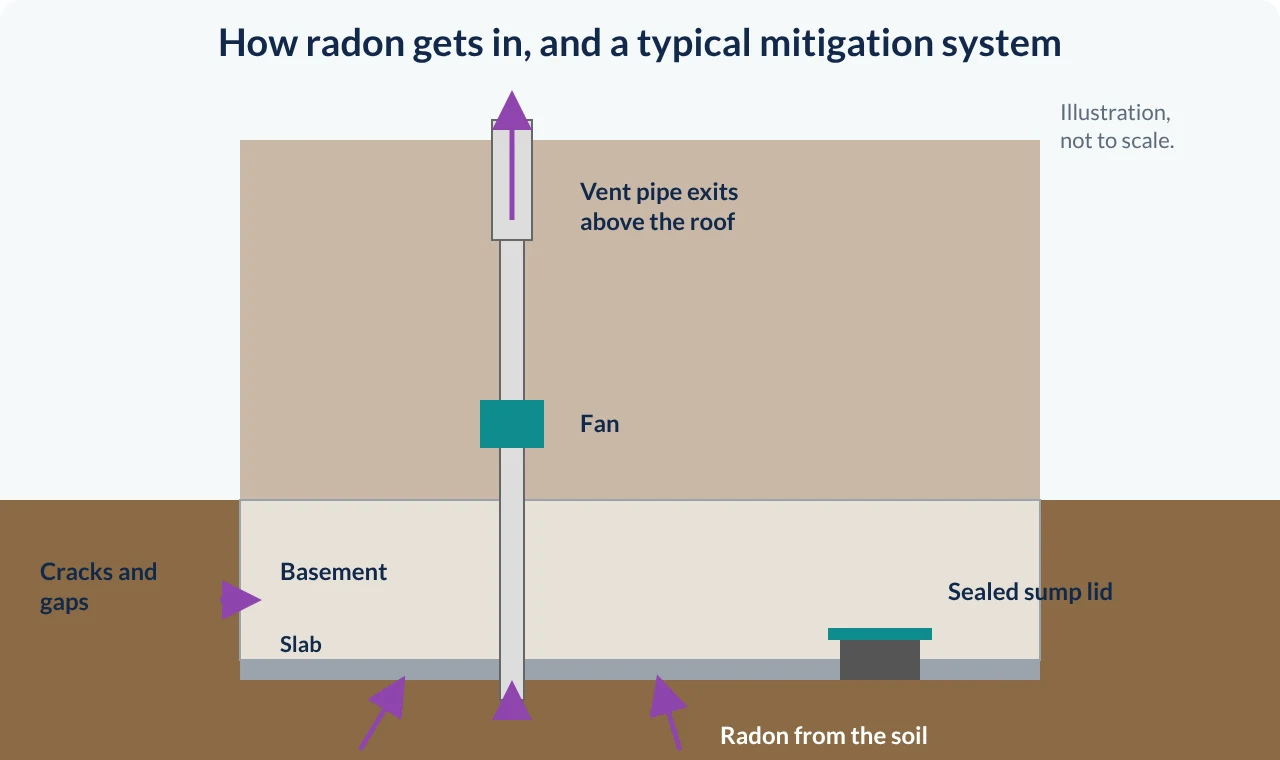
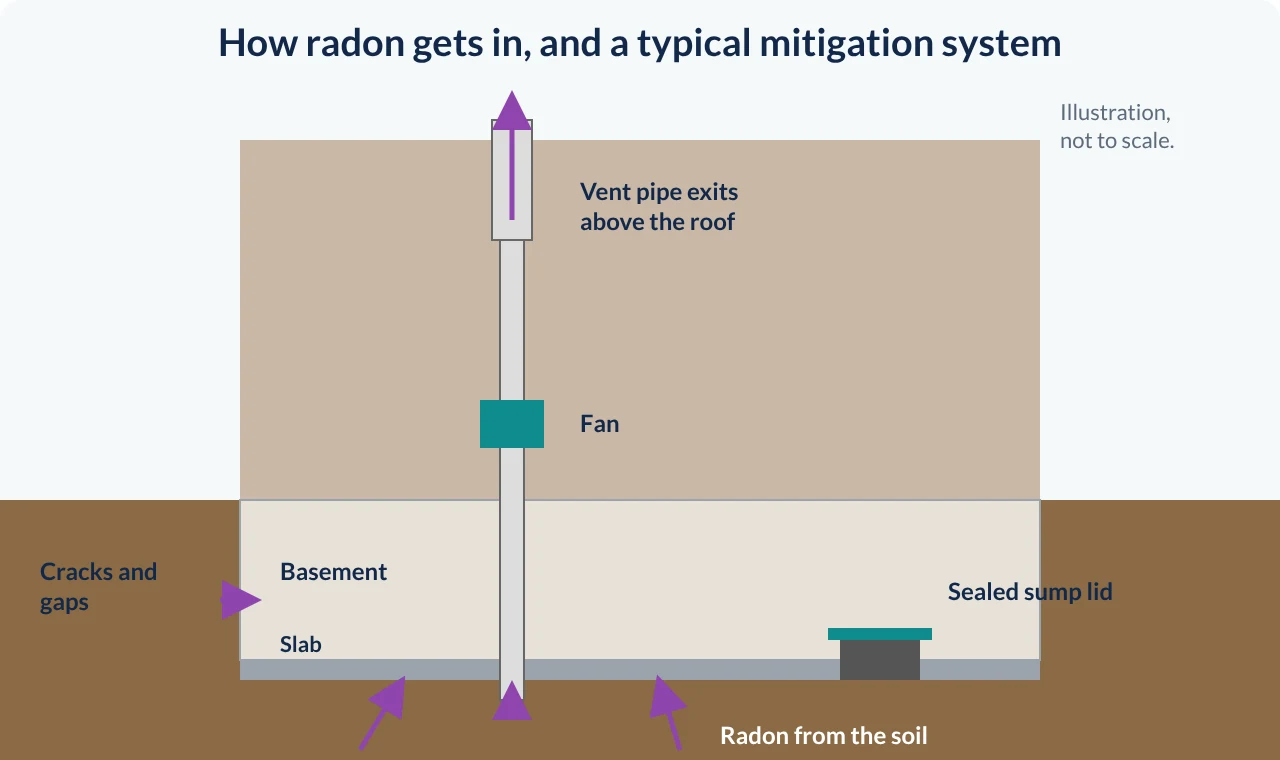
You'll see mitigation systems in many homes. Even without testing, you can describe what's visible:
- A plastic vent pipe coming up through the slab, usually labeled, with a fan in the attic, garage or outside.
- A U-tube gauge (manometer) on the pipe showing whether the fan is pulling.
- Sealed cracks and floor openings, and a sealed sump lid. An open or missing sump lid in a mitigated house defeats part of the system. Note it.
The SOP doesn't require you to judge whether a system works (§ 197-5.16(k)). Recommend asking the seller for recent test results and a follow-up test after the purchase.
Describe this defect
Write it up the way it would go in a report: what it is, where it is, why it matters, and what you'd recommend. It stays in this browser; nothing is sent anywhere.
Model write-up
PLAN FOR. A radon mitigation system was observed in the basement. At the time of the inspection, the gauge on the vent pipe read level on both sides, which can indicate the fan was not drawing air, and the adjacent sump pit had no lid. An open sump pit can let soil gas into the basement and reduce the system's effectiveness. Radon testing is not part of this home inspection. Recommend having a qualified radon mitigation professional check the fan and seal the sump pit, asking the seller for past test results, and retesting after any repair.
Self-check: did your write-up…
Check yourself: 5 questions
Pick an answer to see instantly whether it's right. Your answers are saved in this browser.
Key takeaways
- Radon is an odorless radioactive gas from soil; the only way to know the level is to test.
- NY law: a home inspection does not include radon. NY doesn't license radon testers, but results must come from an NYS DOH ELAP-certified lab.
- EPA action level: fix the home at 4 pCi/L or higher.
- Short-term tests run 2 to 90 days; for a sale, at least 48 hours, with closed-house conditions 12 hours before tests of 2 to 4 days.
- 41 NY counties average above 4 pCi/L in basements (DOH), but neighboring homes can differ; note mitigation parts and sealed sump lids.
Finished the lesson? Mark it complete to save your progress in this browser.
Sources
- U.S. EPA: Home Buyer's and Seller's Guide to Radon (2024, PDF)
- NYS Department of Health: Final Report of the NYS Radon Task Force (PDF)
- NYS DOH: Radon Test Results by County, beginning 1987 (open data)
- NYS DOH: Certified Radon Testers (NY does not certify or license testers; ELAP lab rule)
- NRPP: approved initial training courses (lists InterNACHI INACH-3000)
- National Radon Safety Board (NRSB)
- NY Assembly Bill A8450 (2025-2026), proposed radon licensing
- NYS DOS: law and regulations, Real Property Law § 444-b(4) and 19 NYCRR § 197-5.16 (PDF)