Learn › Become a NY Home Inspector › Week 5
Week 5 · Module 2: Interior, insulation, ventilation & electricalInteriors: walls, floors, stairs and ceilings
AI-narrated. A recording by Onelfri is coming soon.
Module 2 moves inside. Interiors look easy because everything is painted and staged, but that's exactly why you slow down. Fresh paint, new flooring and a rug in the wrong place can all be hiding something. I walk every room the same way: floor, walls, ceiling, then whatever the SOP asks me to operate.
What the SOP asks inside
Under 19 NYCRR § 197-5.12 you observe and report on:
- The material and general condition of walls, ceilings and floors.
- Steps, stairways and railings.
- Garage doors, garage door safety devices and operators, which you also operate.
- Bath and kitchen vent fan ducting, where visible and readily accessible, to see if it exhausts outside.
- A representative number of primary windows and interior doors, which you operate (next lesson).
- Visible signs of water penetration.
You are not required to report on paint, wallpaper and other finishes, window treatments, central vacuums or household appliances. Report the condition of the surface, not whether you like the color.
What I look for room by room: cracks over doors and windows, sloping or bouncy floors, loose or cracked tile, ceiling stains, and bath fans that vent into the attic instead of outside.
Signs of hidden water
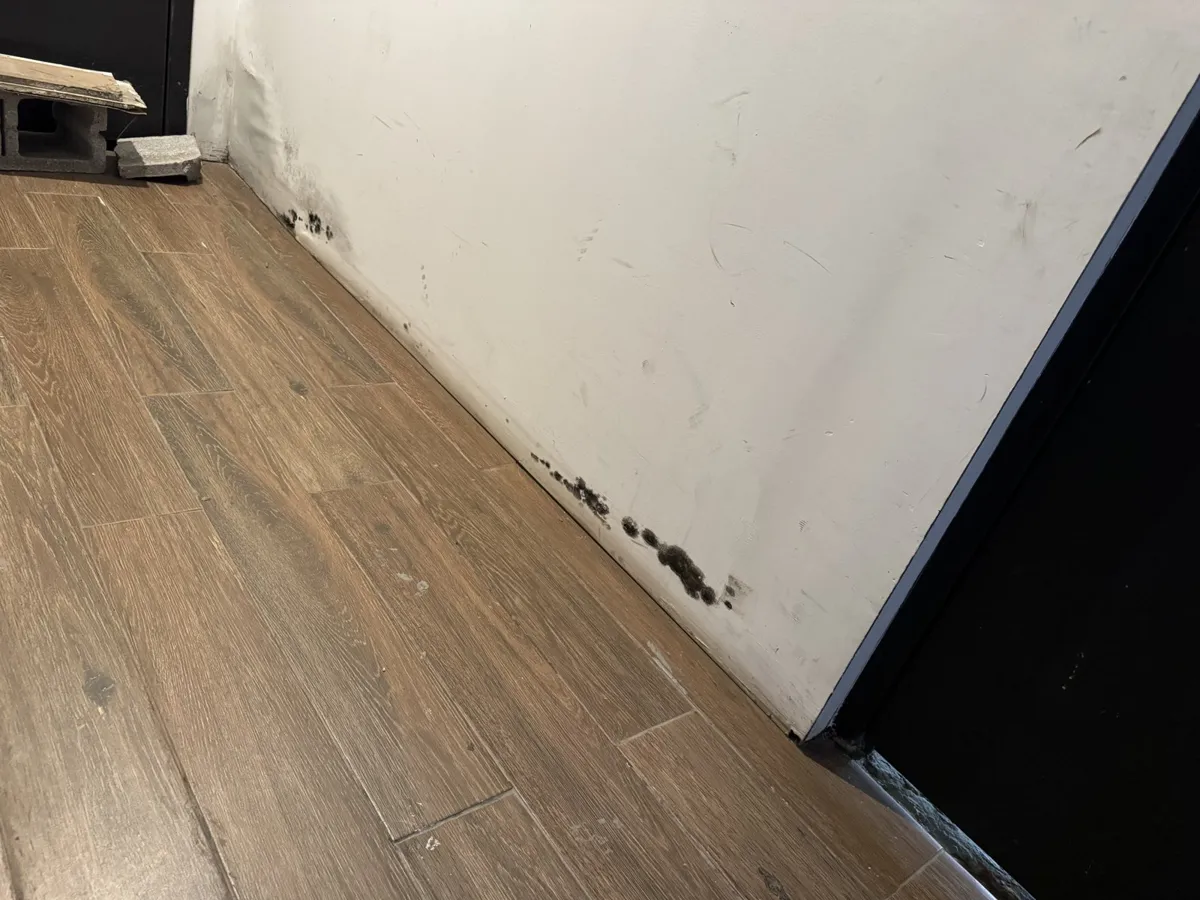
Water damage inside usually shows up as:
- Stains, bubbling paint or soft drywall on ceilings below bathrooms and on exterior walls.
- Dark growth or swelling at the base of walls and trim.
- Cupped or buckled wood floors, loose tiles, and stains around toilets and tubs.
- Fresh paint on one spot of a ceiling. Ask about it.
Use your moisture meter on every stain. "Dry at the time of the inspection" is a useful sentence, but it doesn't mean the problem is fixed, so recommend asking the seller about the history. The SOP doesn't require you to determine whether mold is present (§ 197-5.16(k)), so call it "suspected mold" and recommend finding and fixing the moisture source.
Stairs and railings
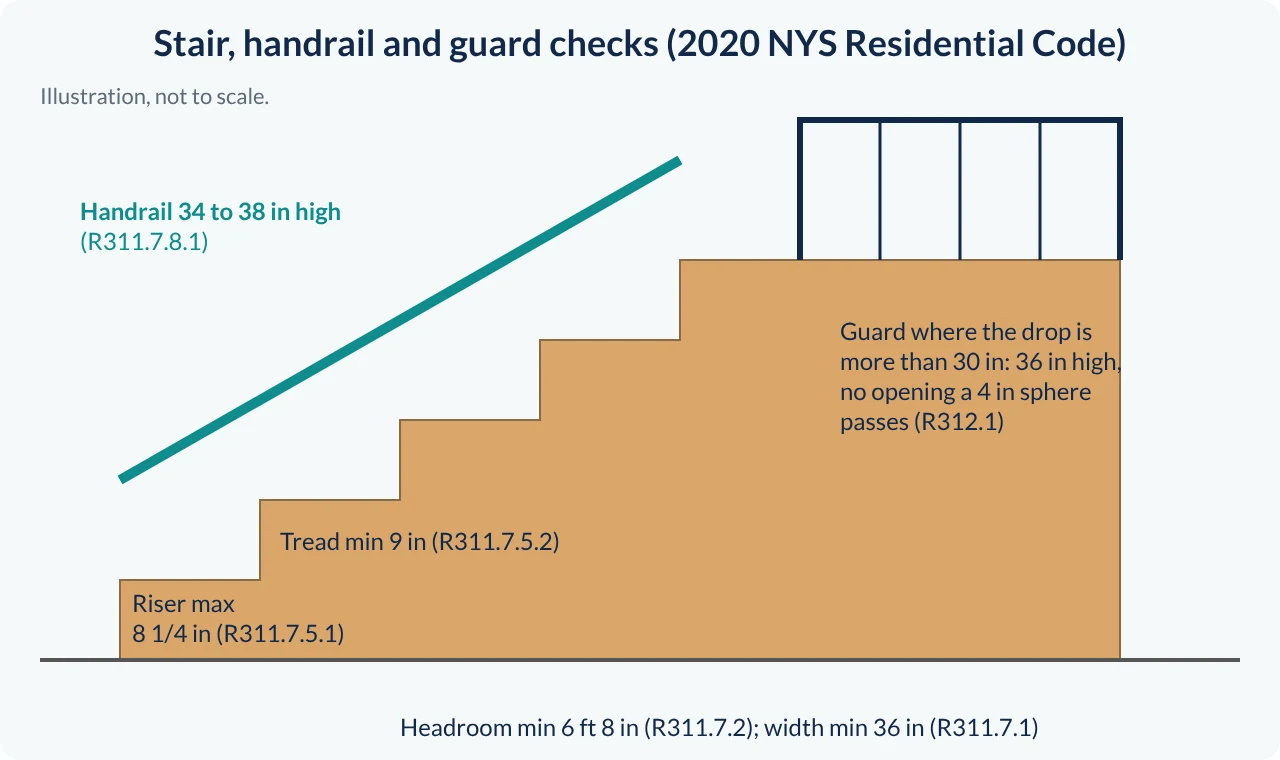
Stairs are where people get hurt, so I check every flight. Look for loose or missing handrails, uneven steps, loose treads, low headroom and open guards. The 2020 NYS Residential Code limits for newer work: risers no taller than 8 1/4 inches and treads at least 9 inches deep (R311.7.5), with no more than 3/8 inch difference between the biggest and smallest in a flight. Handrails go 34 to 38 inches high (R311.7.8.1). Guards are required where the drop is more than 30 inches, at least 36 inches high, with no openings a 4-inch sphere can pass (R312.1).
Those NY numbers are different from the national IRC, so don't mix them up. A tip from my training: mark a stick at the measurements you check most, and you won't need to pull out a tape at every step. Uneven risers in a flight are a trip hazard even if each one is within the limit.
Garages, alarms and how to write it up
Attached garages. Operate the garage door and test the auto-reverse safety devices the way the manufacturer intends, if it's safe. For the wall and door between the garage and the house, the code for newer work calls for at least 1/2-inch gypsum board on the garage side (R302.6) and a solid wood or steel door at least 1 3/8 inches thick, or a 20-minute fire-rated door, with a self-closer (R302.5.1). No opening from a garage directly into a bedroom. Note holes in the drywall, a hollow-core door or a missing closer.
Smoke and CO alarms. They aren't on the SOP interior list, but I note what I see. In NY, Amanda's Law requires carbon monoxide alarms in homes with fuel-burning appliances or an attached garage, and since April 1, 2019, battery-only smoke alarms sold in NY must have a sealed 10-year battery. Write that alarms were observed (or not) in the hallway, the bedrooms and on each level, and recommend testing them and replacing old ones. Don't certify that they work.
Describe this defect
Write it up the way it would go in a report: what it is, where it is, why it matters, and what you'd recommend. It stays in this browser; nothing is sent anywhere.
Model write-up
PLAN FOR. Dark, spotty growth (suspected mold) was observed along the base of the basement wall in the area shown, just above the floor. Growth like this needs moisture, so it indicates the area has been wet. Lab testing would be needed to identify it, and the extent behind the wall is not visible. Recommend checking the area with a moisture meter, finding and correcting the moisture source, and having damaged materials cleaned or replaced by a qualified contractor. Ask the seller about past leaks or flooding here.
Self-check: did your write-up…
Check yourself: 5 questions
Pick an answer to see instantly whether it's right. Your answers are saved in this browser.
Key takeaways
- § 197-5.12: walls, ceilings, floors, stairs and railings, garage doors, vent fan ducting, a representative number of windows and doors, and signs of water.
- Check every stain with a moisture meter, call growth 'suspected mold' and look for the water source.
- NY newer-work stair limits: risers max 8 1/4 in, treads min 9 in, handrails 34 to 38 in, guards 36 in where the drop is over 30 in.
- Garage-to-house door: solid wood or steel 1 3/8 in or 20-minute rated, self-closing (R302.5.1).
- Note smoke and CO alarms as observed; NY's Amanda's Law requires CO alarms in many homes.
Finished the lesson? Mark it complete to save your progress in this browser.